Cricket Ground Construction in Hyderabad
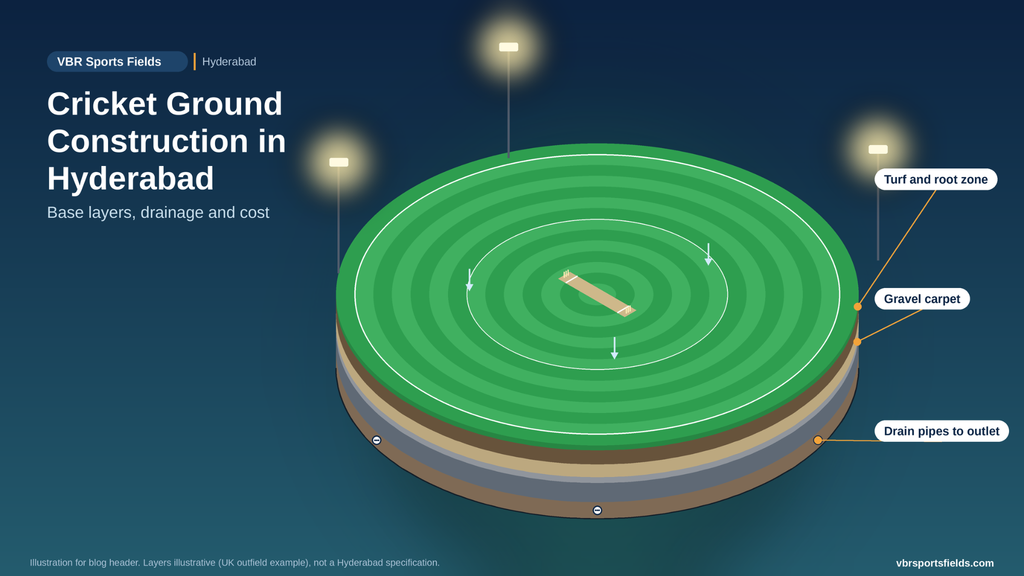
Cricket ground construction in Hyderabad is priced by ground type, not by one rate. Published Indian ranges run from ₹10 to ₹25 lakh for a basic academy ground to ₹60 lakh to ₹1.5 crore at district level. Pitch type, outfield, drainage and lights drive most of the spread. Always confirm whether land is included.
What Sits Under the Grass Decides What You Pay Later
Two cricket grounds can look identical on handover day and behave very differently after the first monsoon. The difference is almost always underneath: the grading, the layers and the drains.
This guide explains cricket ground construction from the bottom up. It covers base layers, how a sports ground drainage system works, cricket pitch construction cost and the budget for each ground type, so you can read a quote line by line.
Key takeaways
- Published ground budgets run from ₹10 lakh (basic academy) to ₹5 crore (state-level practice), so scope matters more than size.
- Grading, base layers and drainage are hard to fix later, so they deserve budget first.
- Clay, synthetic and cemented turf pitches are priced very differently.
- Compare quotes layer by layer, not by the total.
How Much Does Cricket Ground Construction in Hyderabad Cost?
Published ranges for India put a basic academy ground at ₹10 to ₹25 lakh, a school or college ground at ₹25 to ₹60 lakh, and a district-level ground at ₹60 lakh to ₹1.5 crore. State-level and practice grounds reach ₹2 to ₹5 crore. Treat these as planning ranges, not Hyderabad quotes.
| Ground type | Published cost range |
|---|---|
| Basic academy ground | ₹10 to ₹25 lakh |
| School or college ground | ₹25 to ₹60 lakh |
| District-level ground | ₹60 lakh to ₹1.5 crore |
| State-level or IPL practice ground | ₹2 to ₹5 crore |
These ranges come from an A.S Sports and Infra cost guide, updated August 2026 by a Noida-based contractor. No Hyderabad-specific price list turned up, so local quotes will differ with soil, rainfall and site access.
Check what each range includes. The same guide treats land as a separate and large variable, at ₹10 to ₹20 lakh per acre in rural areas and far more in metros, and suggests at least 3 to 5 acres for a standard ground.
What Makes Up the Cost of a Cricket Ground?
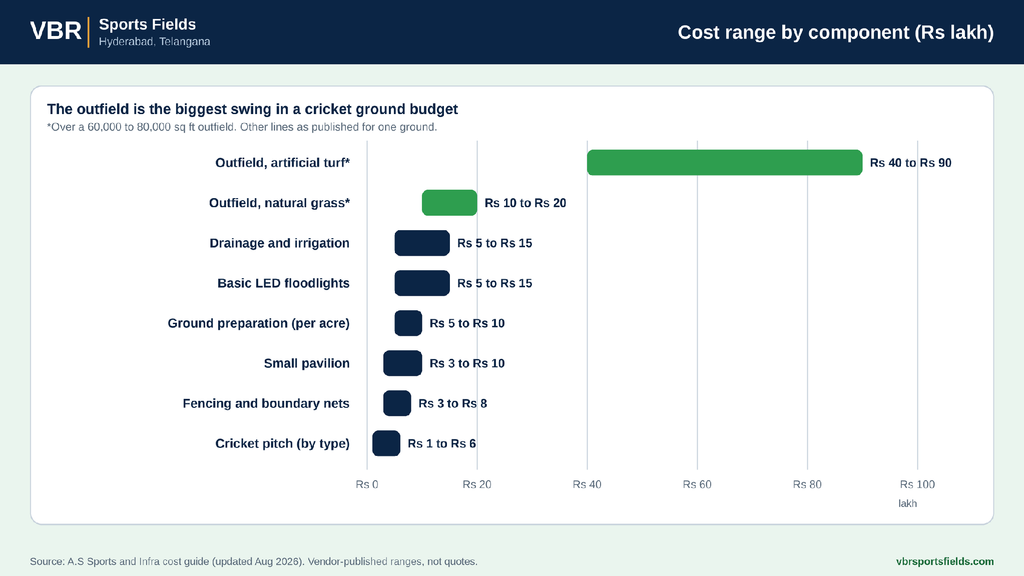
A cricket ground budget splits into ground preparation, pitch, outfield, drainage, fencing, lighting and buildings. The outfield is the swing item: about ₹10 to ₹20 lakh for natural grass against ₹40 to ₹90 lakh for artificial turf over 60,000 to 80,000 sq ft. Drainage is a smaller line but a costly one to get wrong.
- Ground preparation and levelling: ₹5 to ₹10 lakh per acre.
- Drainage and irrigation: ₹5 to ₹15 lakh.
- Fencing and boundary nets: ₹3 to ₹8 lakh.
- Basic LED floodlights (4 to 6 poles): ₹5 to ₹15 lakh.
- Small pavilion or changing room: ₹3 to ₹10 lakh.
Light pole footings are poured during civil works, so plan sports lighting systems before the base is closed, even if the lights are installed later.
Cricket Pitch Construction Cost: Clay, Synthetic or Cemented Turf?
Cricket pitch construction cost depends on pitch type. One contractor guide lists synthetic matting at ₹1 to ₹3 lakh, natural clay at ₹2 to ₹5 lakh and a cemented base with artificial turf at ₹3 to ₹6 lakh. Another guide quotes ₹3 to ₹15 lakh pitch-only, so confirm the footprint.
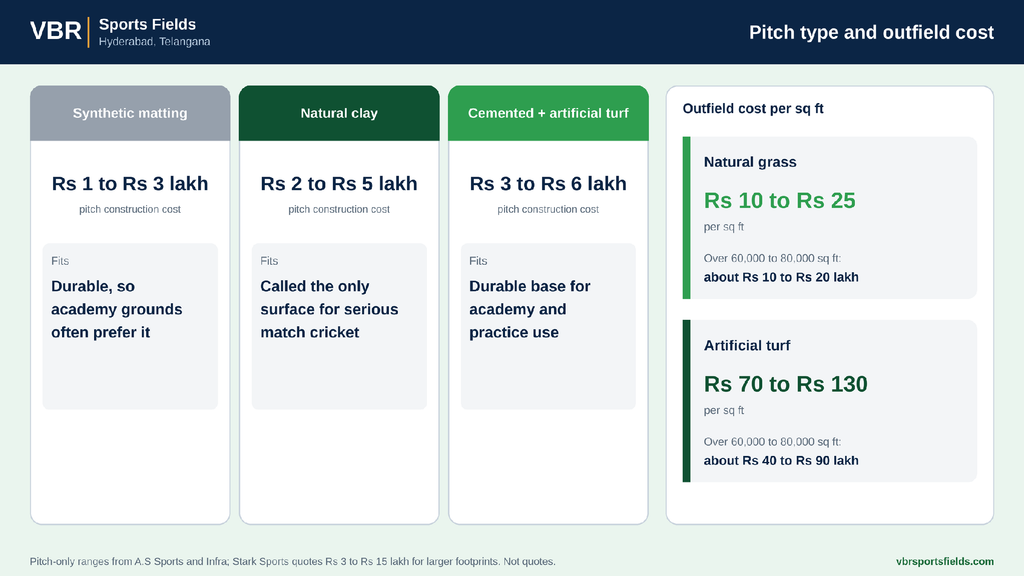
- Natural clay pitch: ₹2 to ₹5 lakh. One guide calls natural turf the only surface for serious match cricket.
- Synthetic matting: ₹1 to ₹3 lakh. Academy grounds often prefer synthetic or cemented pitches for durability.
- Cemented base with artificial turf: ₹3 to ₹6 lakh.
The wider ₹3 to ₹15 lakh figure comes from a Stark Sports guide that prices the pitch plus a run-up footprint of about 2,500 sq ft. The outfield follows similar logic: natural grass at ₹10 to ₹25 per sq ft and artificial turf at ₹70 to ₹130, which makes sports surface installation choices the biggest swing in most budgets. For turf care, see synthetic turf maintenance protocols.
What Base Layers Go Under a Cricket Ground?
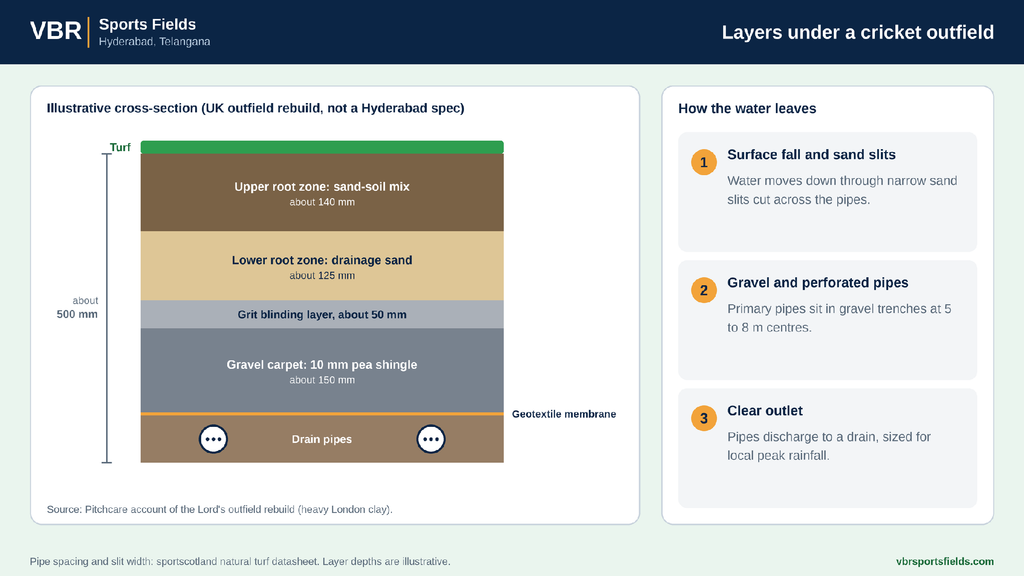
A cricket outfield is built in layers: a graded formation level, drain pipes in trenches, a gravel carpet over a geotextile membrane, a grit blinding layer, drainage sand and a sand-soil root zone. A published rebuild at Lord’s excavated about 500 mm. Hyderabad specifications should follow local soil and rainfall.
- Formation level: about 500 mm below the finished surface.
- Gravel carpet: 10 mm pea shingle, about 150 mm deep, over a semi-permeable membrane.
- Grit blinding layer: about 50 mm, separating gravel from sand.
- Lower root zone: drainage sand, about 125 mm.
- Upper root zone: sand-soil mix, about 140 mm.
Those figures come from a Lord’s outfield rebuild on heavy London clay, so they show the principle, not a Hyderabad specification. VBR Sports Fields describes its own civil construction sequence as site clearing, earthmoving, base construction with drainage trenches and aggregate layers, then laser final grading. The wider case is made in the engineering most sports field owners overlook.
How Does a Sports Ground Drainage System Work?
A sports ground drainage system works in two stages. Surface fall and sand slits move water down, then perforated pipes in gravel-filled trenches carry it to an outlet. sportscotland guidance places primary pipes 5 to 8 m apart with sand slits across them. One contractor guide warns that poor drainage can cost a season of play.
- Primary drains: perforated pipes in trenches backfilled with clean gravel, at 5 to 8 m centres per sportscotland guidance.
- Secondary drains: sand slits cut across the pipes, 50 mm wide in the same guidance.
- Membrane: a geotextile layer keeps clay and silt out of the gravel.
- Outlet: pipes need a clear discharge point, such as a stormwater drain.
- Capacity: sites with heavy rainfall need higher system capacity, so size pipes to local peak rainfall.
Budget about ₹5 to ₹15 lakh for drainage and irrigation together, per the cost guide above. The usual failure points are covered in why sub-base drainage fails.
How Long Does Cricket Ground Construction Take?
VBR Sports Fields lists a stadium-scale sequence of about seven months: site survey in week 1, design in weeks 2 to 4, earthworks and drainage in months 2 to 3, and turf, pitch and building work in months 3 to 7. Scope changes this, so ask every contractor for a dated schedule.
VBR delivers cricket ground construction under one turnkey contract, which keeps civil, turf, lighting and seating on one schedule. Its site lists cricket projects in Hyderabad and in Kadapa, Venkatagiri and Nellore in Andhra Pradesh.
How Do You Compare Cricket Ground Quotes?
Compare quotes layer by layer. Ask each contractor to list grading, base layers, drainage design, pitch type, outfield type, lights and buildings separately, with land and GST stated. Two totals mean little until the scope matches, so settle scope first and price second.
- Which pitch type and footprint does the price cover?
- Is the outfield natural or artificial, and how many sq ft?
- Is there a drainage design with pipe spacing and an outlet?
- Which base layers and geotextile are specified?
- Are lights, nets and pavilion included or excluded?
- Are land, GST and post-handover maintenance covered?
Quick Guide: Which Ground Type Fits Your Plan?
Match the build to the level of play and the upkeep budget. Academies often choose synthetic or cemented pitches for durability, while serious match play points to natural turf. Phase lights and buildings if cash is tight, but lay ducts and footings during civil works.
| Plan | Best fit |
|---|---|
| Academy or coaching centre | Cemented or synthetic pitch, strong drainage, phased extras |
| School or college ground | Outfield by upkeep budget, boundary nets, basic lights |
| District-level match ground | Natural clay pitch, engineered drainage, full lighting plan |
| Tight budget, long horizon | Spend on grading, base and drainage first |
Where Should Your Budget Go First? A Simple Rule to Decide
Spend first on what cannot be fixed later: grading, base layers and drainage. Then choose pitch and outfield by use and upkeep budget, and add lights and buildings last. Cricket ground construction in Hyderabad compares fairly only when every quote lists the same layers.
VBR Sports Fields, based in LB Nagar, Hyderabad, offers a free site feasibility report covering orientation, drainage and a budget band before you commit.
Planning a cricket ground in Hyderabad, Telangana or Andhra Pradesh? Share your site details and the VBR team will help you scope the budget. Get Started or call +91 94920 23333.
Frequently Asked Questions
How much land does a cricket ground need?
One contractor guide recommends at least 3 to 5 acres for a standard cricket ground and 15 to 20 acres for international venues. Land is often the largest and most location-dependent cost, so confirm site size and ownership before you ask for construction quotes.
Is natural grass or artificial turf better for a cricket outfield?
It depends on use. One 2026 guide says a serious match-play club still needs natural grass, while a high-usage practice or academy facility often does better on turf. Natural grass costs less per sq ft to lay but needs near-daily rolling, mowing and watering in season.
Can floodlights be added after the ground is built?
Yes, but plan early. A published account of a Yorkshire outfield rebuild shows ducts laid around the ground during the works to allow floodlighting later. Ask your contractor to include ducts and pole footings in the civil stage, even if the lights are phased.
Is basic grading enough for drainage?
Usually not. Grading shapes surface falls, but water that enters the soil needs designed pipes and layers to leave. A drainage guide for athletic fields says surface grading alone is not enough, and VBR makes the same distinction between designed drainage and basic grading.
How much does it cost to maintain a cricket pitch each year?
One 2026 guide puts a natural grass pitch at about ₹1 to ₹5 lakh a year against ₹20,000 to ₹50,000 for artificial turf. Mowing the infield and outfield is a separate running cost, so ask for a maintenance plan with the quote.
Sources
A.S Sports and Infra, cricket ground cost guide (ground tiers, components, land)
Stark Sports, Cricket Pitch Cost Per Square Foot in India (pitch-only range)
Stark Sports, Natural Grass vs Artificial Turf Maintenance Cost (annual upkeep, surface choice)
Pitchcare, Out with the outfield, in with the new (Lord’s) (layer depths)
Pitchcare, Mud to Ashes (Yorkshire CCC outfield rebuild) (floodlight ducts)
sportscotland, Natural Turf Datasheet (pipe spacing, sand slits)
SiteOne, Designing Subsurface Drainage for Athletic Fields and Parks (grading and drainage capacity)
VBR Sports Fields, Civil Construction and Cricket Infrastructure pages (company-stated)
Leave a Reply