Pickleball and Padel Court Construction in Hyderabad
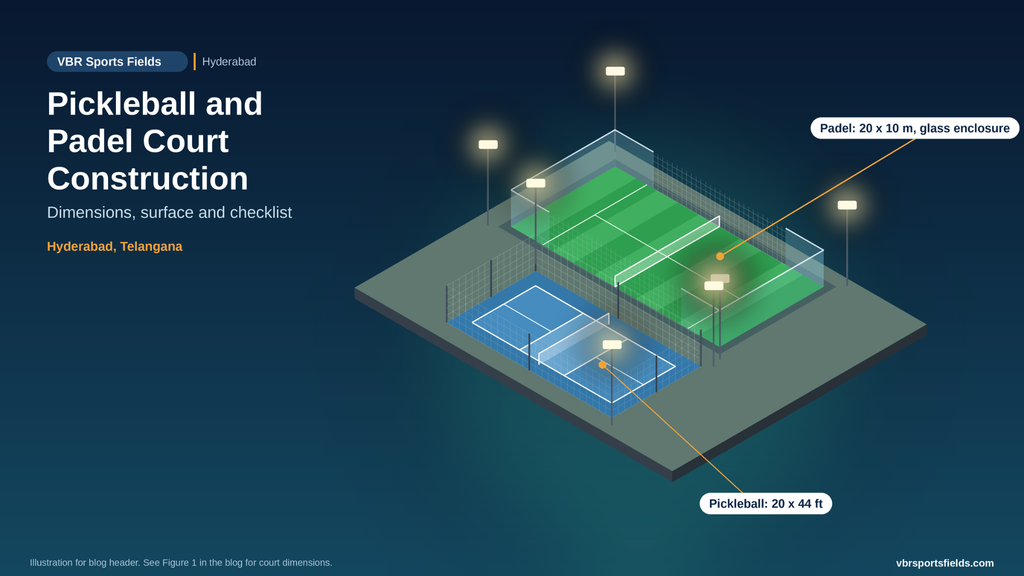
Pickleball court construction in Hyderabad starts with the footprint: a 20 x 44 ft playing court inside a recommended 30 x 60 ft area. Most Indian guides put an outdoor acrylic court at ₹3 to ₹9 lakh, while a padel court runs ₹18 to ₹45 lakh in most guides. Scope, surface and enclosure explain the gap.
Two Courts, One Plot: Why Planning Comes Before Pricing
Pickleball and padel both fit on small plots, which is why housing societies, clubs and resorts are adding them. But a court is only small on paper. A wrong footprint, a flat slab or a weak enclosure is expensive to fix once the surface is down.
This guide covers pickleball court construction in Hyderabad, from pickleball court dimensions to padel court construction cost, surface choices and a planning checklist, so you can compare quotes on the same terms.
Key takeaways
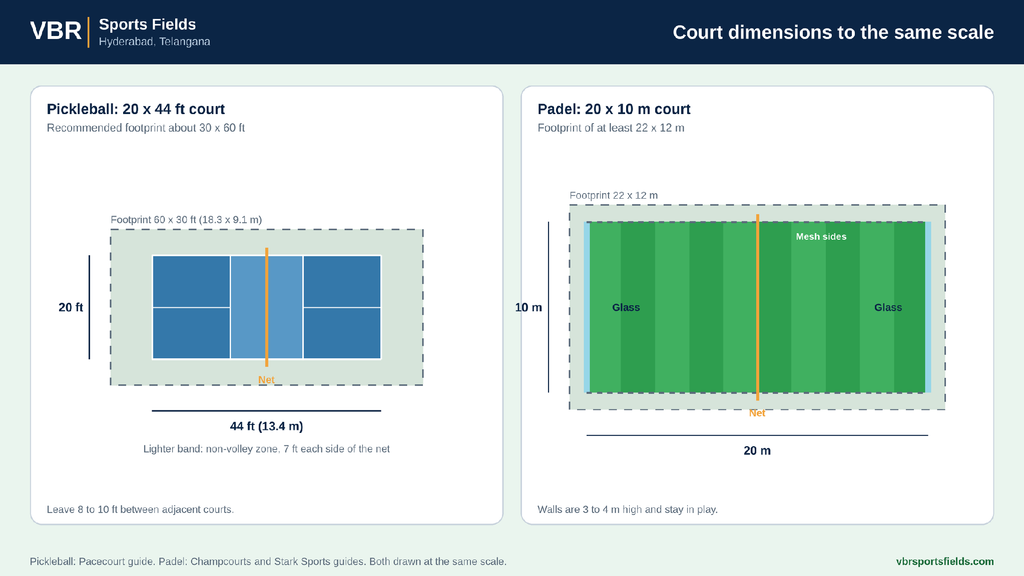
- A pickleball court is 20 x 44 ft but needs about 30 x 60 ft. A padel court is 20 x 10 m and needs at least 22 x 12 m.
- Published pickleball budgets cluster at ₹3 to ₹9 lakh, and padel at ₹18 to ₹45 lakh.
- Base, slope and drainage are set before the surface, so plan them first.
- Compare quotes by footprint, fencing and lighting, not by the total.
What Are the Pickleball Court Dimensions?
A pickleball court measures 20 x 44 ft (6.1 x 13.4 m) for singles and doubles. The non-volley zone extends 7 ft from the net on each side. Net height is 36 in at the posts and 34 in at the centre. Builders recommend a 30 x 60 ft footprint, about 1,800 sq ft, for safe run-off.
| Item | Measure |
|---|---|
| Playing court | 20 x 44 ft (6.1 x 13.4 m) |
| Non-volley zone | 7 ft from the net, each side |
| Net height | 36 in at posts, 34 in at centre |
| Recommended footprint | About 30 x 60 ft per court |
| Gap between courts | At least 8 to 10 ft |
| Perimeter fence | 8 to 10 ft high |
These figures follow a Pacecourt guide. It also advises a north-south alignment to keep low sun out of players’ eyes, and about 5.5 m of clearance for indoor courts. The same guide says one tennis court can be converted to fit four pickleball courts.
What Are the Dimensions and Space Needs of a Padel Court?
A padel court is 20 x 10 m, enclosed by 3 to 4 m walls of glass and mesh that stay in play. One Indian guide advises a footprint of at least 22 x 12 m. The enclosure adds structural needs that tennis and pickleball courts lack, including wind-load checks for the glass.
- Glass: 10 mm panels are common on standard courts and 12 mm on panoramic ones.
- Frame: a galvanized steel frame carries the glass and mesh.
- Turf: padel-specific monofilament turf with silica sand infill.
- Lighting: VBR lists four LED posts mounted on the corner columns.
- Site survey: VBR lists soil bearing capacity, wind load zone, slope and electrical supply as first checks.
Which Surface Works Best for Pickleball and Padel Courts?
Pickleball courts in India are most often acrylic over a concrete base, with cushioned systems for heavy use. Padel courts use monofilament artificial turf with silica sand infill inside a glass and steel enclosure. Surface choice changes comfort, upkeep and cost, so specify it in writing.
- Acrylic, 2-coat: ₹45 to ₹150 per sq ft, and ₹150 to ₹300 for cushioned 4 to 8 coat systems.
- Resurfacing: guides suggest 5 to 8 years for acrylic before recoating.
- Modular tiles: quick to install, but thin cheap tiles can bow and separate within a couple of seasons.
- Padel turf: about ₹1.5 to ₹3 lakh per court, with replacement every 6 to 10 years in one guide.
For upkeep habits, see extending the life of acrylic surfaces.
How Much Does Pickleball Court Construction in Hyderabad Cost?
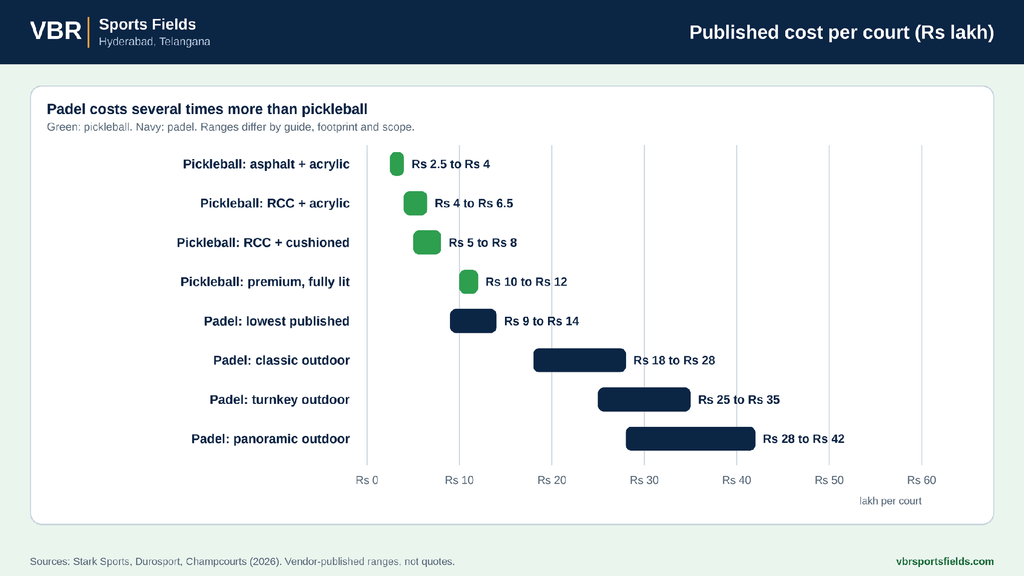
Published Indian guides put a standard outdoor acrylic pickleball court at ₹3 to ₹9 lakh. Budget asphalt builds sit near ₹2.5 to ₹4 lakh, and cushioned or lit builds reach ₹8 to ₹12 lakh. Indoor courts run ₹10 to ₹15 lakh. No Hyderabad-only price list turned up.
| Build | Published range, one court |
|---|---|
| Asphalt base with acrylic | ₹2.5 to ₹4 lakh |
| RCC slab with acrylic | ₹4 to ₹6.5 lakh |
| RCC with cushioned acrylic | ₹5 to ₹8 lakh or more |
| Fenced, lit, tournament-capable | ₹7 to ₹9 lakh |
| Premium cushioned with full lighting | ₹10 to ₹12 lakh |
These figures come from Stark Sports guides and a tournament cost guide, and assume about 30 x 60 ft for recreational courts and 34 x 64 ft for tournament builds. Other guides range wider, from about ₹1.5 lakh to ₹16 lakh, so ask what footprint, fencing and lighting a quote includes. Four-court sites are quoted at ₹14 to ₹35 lakh because civil and fencing costs are shared.
What Is the Padel Court Construction Cost in India?
Padel court construction cost in India runs ₹18 to ₹45 lakh in most 2026 guides. One guide lists ₹9 to ₹14 lakh but warns that quotes under ₹7 lakh usually cut corners. Glass grade, panoramic walls, lighting and an indoor roof drive the spread.
- Structure and enclosure: ₹8 to ₹12 lakh.
- Glass panels and fencing: ₹4 to ₹7 lakh.
- Artificial turf: ₹1.5 to ₹3 lakh.
- Net and accessories: ₹50,000 to ₹1 lakh.
Those components come from a FranchiseIndia estimate that totals ₹18 to ₹33.5 lakh with lighting and installation. A Durosport guide lists classic outdoor courts at ₹18 to ₹28 lakh, panoramic outdoor at ₹28 to ₹42 lakh and indoor panoramic at ₹35 to ₹55 lakh. Two courts built together cost roughly 15 to 20% less per court, per two guides.
Planning Checklist: What to Settle Before You Break Ground
Plan in this order: site and soil check, footprint and orientation, base and drainage, surface and enclosure, lighting and fencing, then permissions and handover. VBR Sports Fields lists a seven-week sequence from survey to handover. Fix the layout before you compare prices.
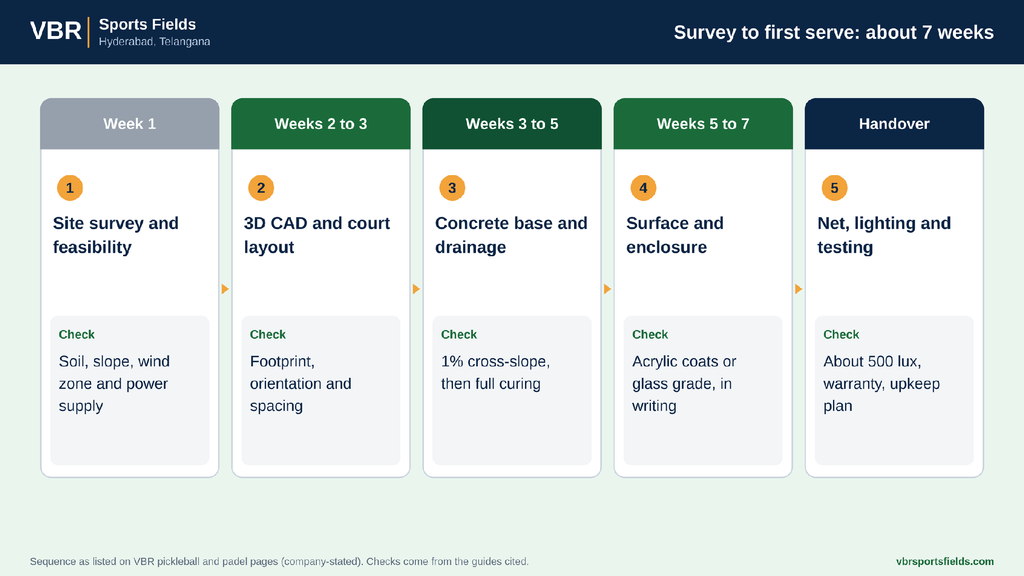
- Site and soil: check bearing capacity, slope and, for padel, wind zone and power supply.
- Footprint: allow 30 x 60 ft per pickleball court and at least 22 x 12 m per padel court.
- Base: specify a concrete slab or asphalt with a cross-slope for run-off, and let concrete cure before coating. VBR lists a 1% cross-slope.
- Surface and enclosure: get the acrylic coats, glass grade and steel spec in writing.
- Lighting and fencing: keep LED poles outside sightlines. VBR lists about 500 lux.
- Permissions and handover: confirm land-use rules with the local authority, and agree warranty and maintenance terms.
VBR describes its sports facility design process as site analysis, structural design, 3D simulation and an execution plan, with lighting lux simulations before build. The base is civil construction, and LED sports lighting should be modelled before poles are fixed. Weak drainage puddles courts too, as explained in why sub-base drainage fails.
How Long Does Construction Take, and What Does Upkeep Cost?
Guides quote roughly 4 to 8 weeks for a single outdoor pickleball court, mostly because concrete must cure, and about 4 weeks for padel. VBR lists seven weeks from survey to handover. Yearly upkeep runs ₹40,000 to ₹1.5 lakh for acrylic courts and ₹30,000 to ₹60,000 for padel.
Rain slows curing, so one guide says many builders start between October and February. Padel upkeep means weekly turf brushing and an annual sand top-up. Turf care habits are covered in synthetic turf maintenance protocols.
Quick Guide: Pickleball, Padel or Both?
Pickleball suits tight plots and lower budgets. Padel suits venues that can fund a glass enclosure and want a premium draw. Converting an existing tennis or badminton court is usually cheaper than building new, because the base and fencing are already there.
| Situation | Better fit |
|---|---|
| Spare tennis or badminton slab | Convert to pickleball with resurfacing and new lines |
| Plot under about 1,800 sq ft | One pickleball court |
| Club with ₹18 lakh or more per court | Padel, with a glass enclosure |
| Junior or academy programme | Cushioned acrylic pickleball surface |
| Several courts planned | Build together to share civil and fencing costs |
Where Should You Start? A Simple Rule to Decide
Fix the footprint, slope and base first, then choose the surface and enclosure. Ask every contractor to state court size, fencing and lighting in the quote. Pickleball court construction in Hyderabad only compares fairly when each quote covers the same area and scope.
VBR Sports Fields, based in LB Nagar, Hyderabad, offers a free site feasibility report for pickleball court construction and padel court construction, covering orientation, slope and a budget band.
Planning a pickleball or padel court in Hyderabad, Telangana? Share your plot size and the VBR team will help you scope the layout and budget. Get Started or call +91 94920 23333.
Frequently Asked Questions
Can a tennis or badminton court be converted for pickleball?
Yes. One guide says resurfacing and new line markings cost less than building from scratch because the base and often the fencing already exist. It adds that a single tennis court can be converted to fit four pickleball courts. Check slab flatness and slope first, since an uneven base cracks the new surface.
Is acrylic or tile flooring better for a pickleball court?
Acrylic over concrete is the usual outdoor choice because it gives consistent bounce and grip. Modular tiles install faster, but one guide warns that thin, cheap tiles can bow and separate within a couple of seasons and advises 8 mm thickness or more if you go that route.
Do I need permission to build a padel or pickleball court?
Confirm land-use rules with your local authority before construction, especially for commercial or society projects. Housing societies also need resident association approval. A padel enclosure additionally needs a structural and wind-load check for the glass, so ask your contractor to share the calculation.
What lighting do pickleball and padel courts need?
Glare control matters more than raw brightness. One guide advises LED fixtures at a proper height so shadows do not fall across the non-volley line, and VBR lists about 500 lux with poles outside sightlines. Ask for a lux simulation before approving a lighting layout.
How often does an acrylic pickleball court need resurfacing?
Guides suggest 5 to 8 years before resurfacing, and one lists 6 to 9 years for acrylic-coated courts. Built-in UV protection in the acrylic system extends life. Recoating costs a fraction of the original installation, so budget for it from day one.
Sources
Pacecourt, Pickleball Court Construction guide (2026) (dimensions, surfaces, upkeep)
Pacecourt, Pickleball Court Building in India (acrylic life)
Stark Sports, Pickleball Court Construction Cost in India (pickleball build ranges)
Stark Sports, Tournament-Standard Pickleball Court Cost (tournament ranges)
Turf8, Pickleball Court Construction Cost in India (indoor range, timeline)
Champcourts, Padel Court Construction Cost in India (court size, glass, cost)
Durosport, How Much Does a Padel Court Cost in India (court types, turf life)
FranchiseIndia, Padel Court Business in India (component costs)
Stark Sports, Padel Court for Housing Societies (footprint, upkeep)
Stark Sports, Padel Court Construction Cost in India (low-end quotes warning)
Wikipedia, Padel (wall height)
VBR Sports Fields, Design & Engineering, Pickleball and Padel pages (company-stated process and timeline)
Leave a Reply