Starting a sports infrastructure project is exciting — but it is also one of the most complex undertakings a school, municipality, sports academy, or private developer can take on. From site surveys to material selection, from obtaining statutory approvals to managing contractor timelines, there are dozens of moving parts that must align perfectly.
In India, sports infrastructure investment is growing rapidly.Yet a significant portion of these projects overrun their budgets, miss deadlines, or deliver substandard facilities — not because of bad intentions, but because of avoidable planning errors.
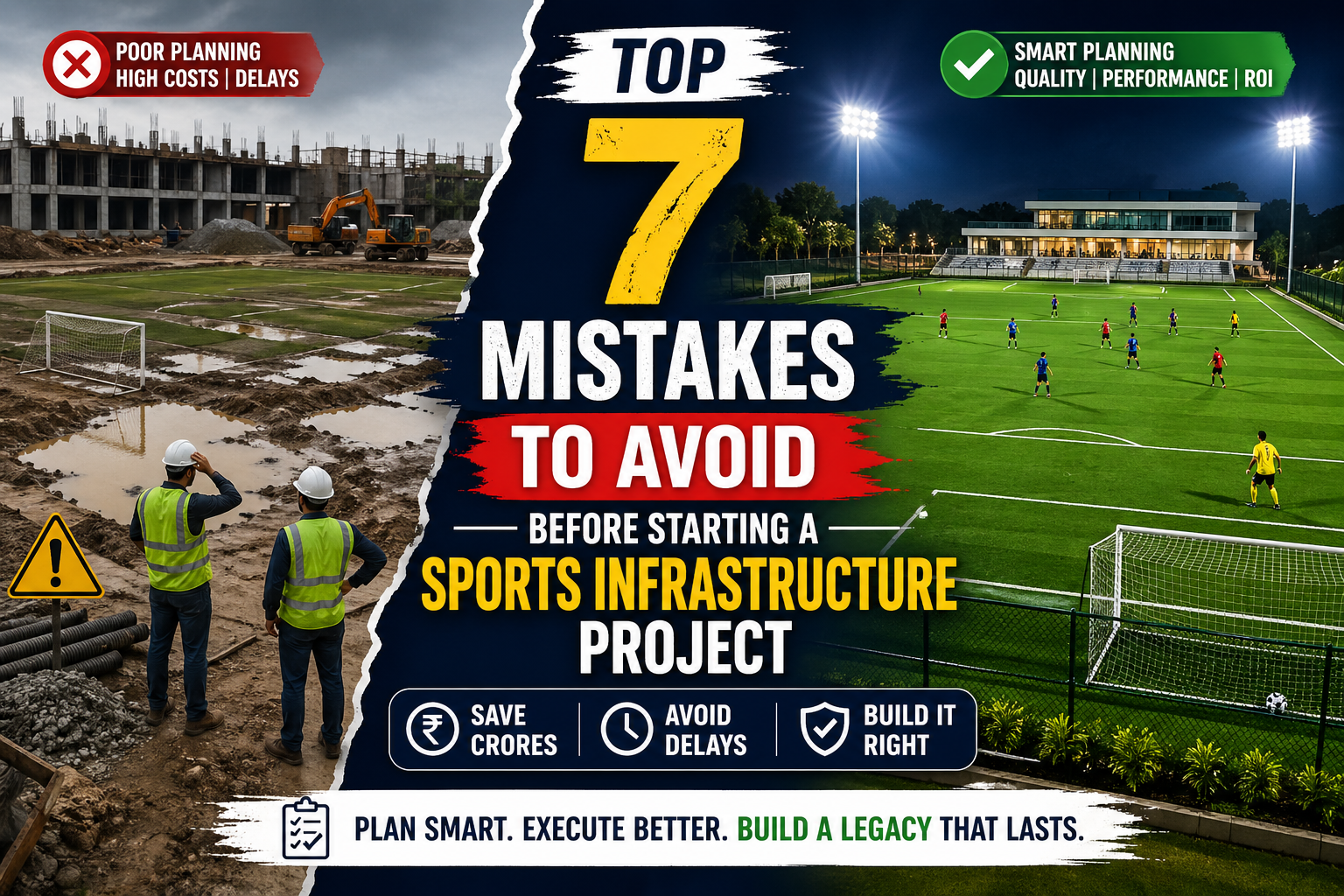
This article identifies the top 7 mistakes that derail a sports infrastructure project before it even gets off the ground — and shows you exactly how to sidestep each one.
Why Getting the Foundation Right Matters
A sports infrastructure project is not like a standard construction project. It involves specialised surfaces, precise drainage engineering, sport-specific dimensions, governing body certifications, and ongoing operational planning — all of which must be baked into the project from Day One.
Mistakes made in the planning phase are exponentially more expensive to correct once construction begins. A drainage system installed incorrectly costs five times more to fix after the turf is laid than before. A field oriented the wrong direction cannot be rotated once the concrete subbase is poured. These are not hypothetical scenarios — they happen regularly on sports construction projects across India where proper sports facility planning was skipped or rushed.
Understanding these common pitfalls is the first step toward a successful project execution.
Mistake #1: Skipping a Professional Feasibility Study
Why This Happens
Many project owners — especially first-time sports facility developers — assume that having land and a budget is enough to begin. They skip the feasibility study to save time and move straight to contractor conversations.
Why It Is a Costly Error
A professional feasibility study evaluates soil bearing capacity, drainage gradients, proximity to utilities, zoning compliance, flood risk, and access roads. Without this data, you may begin construction on a site that is fundamentally unsuitable for the intended sports surfaces — leading to waterlogging, foundation failure, or regulatory rejection down the line.
In India, soil conditions vary dramatically between regions. Black cotton soil in Maharashtra and Telangana, for example, expands and contracts significantly with moisture changes — making it particularly problematic for sports construction without proper sub-base treatment. A feasibility study flags these issues before a single rupee is spent on construction.
How to Avoid It
Commission a geotechnical survey and drainage assessment before finalising your site. Engage a sports infrastructure consultant — not just a general civil engineer — who understands the specific load-bearing and drainage requirements of sports field surfaces. Budget ₹1.5–4 lakh for this study; it can save you ₹20–50 lakh in remediation costs later.
Mistake #2: Ignoring Sport-Specific Design Standards
Why This Happens
Project owners often rely on generic architects or civil contractors who design the facility based on approximate dimensions rather than the precise standards mandated by governing bodies.
Why It Is a Costly Error
Every sport has non-negotiable dimension standards. FIFA –International Federation of Association Football, specifies exact pitch dimensions, goal dimensions, run-off zones, and surface performance parameters. The FIH mandates specific turf types and shock absorption for hockey. The BCCI (Board of Control for Cricket in India) and ICC ( International Cricket Council) have pitch preparation standards that demand precise soil composition and grass species.
A football ground built 5 metres too narrow, or a basketball court with incorrect free-throw line positioning, cannot host sanctioned tournaments. This makes the entire sports infrastructure project commercially unviable for its primary purpose — a devastating outcome after crores of investment.
How to Avoid It
Build your field development checklist around the official technical documentation of the governing body for your sport. Download FIFA’s Football Turf Quality Programme manual, FIH’s Facility Guide, or the relevant national federation’s construction handbook. Engage a sports design specialist who has worked on certified facilities. Never assume — always verify.
Mistake #3: Underestimating the Budget — Especially Hidden Costs
Why This Happens
Initial project quotations focus on visible line items — turf, concrete, lighting, fencing. Hidden costs are either not mentioned or glossed over, leading project owners to approve budgets that are fundamentally insufficient.
Why It Is a Costly Error
In sports facility planning, the visible costs are just the beginning. Common hidden costs in Indian sports construction projects include:
- Site levelling and earthwork: Can add ₹8–20 lakh on sloped or uneven sites
- Drainage infrastructure: Proper subsurface drainage for a football pitch can cost ₹10–25 lakh alone
- Statutory approvals and NOCs: Environmental clearances, municipal permissions, and fire NOCs can add 3–6 months and ₹2–8 lakh
- Utility connections: Bringing power, water, and sewage to a remote sports site can cost ₹5–15 lakh
- Contingency buffer: Inflation in material costs — particularly steel, sand, and synthetic turf — can add 10–20% to budgets in a single year
A sports infrastructure project that begins without a 15–20% contingency reserve almost always runs into financial distress mid-construction.
How to Avoid It
Request an itemised Bill of Quantities (BOQ) from your contractor — not a lump-sum quote. Have an independent quantity surveyor or project manager review it. Build a minimum 15% contingency into your budget from Day One, and treat your initial approved figure as a ceiling, not a target.
Mistake #4: Choosing Contractors Based on Price Alone
Why This Happens
Budget pressure, tender processes mandating L1 (lowest bidder) selection, and a lack of awareness about quality differentiation lead many project owners to award contracts purely on cost.
Why It Is a Costly Error
Sports construction is a specialised field, and therefore, it demands a high level of precision and expertise. For instance, laying a FIFA-quality artificial turf, constructing a cricket practice net system, or installing a synthetic athletics track all require certified materials, technical know-how, and strict adherence to millimetre-level tolerances. However, when a general civil contractor without sports infrastructure experience is involved, the risk increases significantly. As a result, corners are often cut — such as using substandard infill, ignoring proper drainage fall specifications, or even skipping essential shock pad layers — ultimately leading to compromised quality and long-term performance issues.
The result? A surface that looks acceptable on Day 1 but fails within 18 months. Repairing or replacing a poorly installed turf system in India costs ₹15–40 lakh — often more than the original installation. Project execution shortcuts are never actually cheap.
How to Avoid It
Evaluate contractors on three criteria equally: technical experience with certified sports projects, quality of materials (ask for test certificates), and financial track record (to ensure they won’t abandon mid-project). Ask for references from at least three completed sports infrastructure projects. Visit those sites. Check if the turf or surface is still performing well after 3–5 years.
Mistake #5: Neglecting Drainage and Sub-Base Engineering
Why This Happens
Drainage is invisible once the surface is laid, so project owners — and cost-cutting contractors — treat it as secondary. It does not make for impressive site visit photographs, so it is often the first item value-engineered out of a tight budget.
Why It Is a Costly Error
Drainage is the single most important engineering component of any sports infrastructure project. A natural grass field without proper subsurface drainage becomes waterlogged and unplayable within hours of heavy rain. An artificial sports turf system installed on a poorly prepared sub-base develops undulations, seam failures, and infill migration within months.
India’s monsoon season makes this doubly critical. Sports facilities in cities like Mumbai, Chennai, Kochi, and Bengaluru receive 1,000–3,000 mm of annual rainfall. A drainage system capable of clearing 50 mm/hour of rainfall is non-negotiable for year-round playability in these regions.
How to Avoid It
Your sports facility planning must include a dedicated drainage design prepared by a civil engineer experienced in sports field construction. The design should specify:
- Surface gradient (typically 0.5–1.0% cross-fall)
- Perforated lateral drain pipe spacing and depth
- Aggregate base depth and grading
- Outlet connection to storm drainage or soakaway
Do not allow drainage to be treated as a standard residential drainage problem — it is not.
Mistake #6: Failing to Plan for Operations and Maintenance from Day One
Why This Happens
Project owners focus all their energy on construction and treat operations as something to figure out after the facility opens. The result is a beautiful facility with no operational plan, no maintenance budget, and no trained staff.
Why It Is a Costly Error
A sports infrastructure project is not complete at inauguration — it is just beginning. Natural grass fields require year-round groundskeeping, irrigation management, pest control, and renovation. Artificial sports turf requires regular brushing, infill replenishment, seam inspections, and surface temperature management. Floodlighting systems need scheduled maintenance. Changing rooms, scoreboards, and spectator infrastructure all have recurring maintenance demands.
Facilities that open without an operations plan typically see their surfaces degrade within 2–3 years — directly undermining the return on investment from the original sports construction project. In India, this is particularly common in government-funded facilities where capital budgets are approved but operational budgets are not.
How to Avoid It
Before your sports infrastructure project breaks ground, prepare an Operational Readiness Plan that includes:
- Annual maintenance budget (typically 3–8% of capital cost per year)
- Staffing plan (groundskeeping, facility management, security)
- Preventive maintenance schedule for all systems
- Revenue model (booking fees, academy tie-ups, event hosting)
The operations plan should be a deliverable of your sports facility planning phase — not an afterthought.
Mistake #7: Not Securing All Statutory Approvals Before Construction Begins
Why This Happens
Eager to begin, project teams start earthwork and site preparation while statutory approvals are still pending — assuming they will arrive in time. This is extremely common in India, where approval timelines can be unpredictable.
Why It Is a Costly Error
Construction without complete statutory clearances is a high-risk gamble. Projects have been stopped mid-way by municipal authorities, NGT orders, or forest department interventions — leaving half-built structures that cannot be used, insured, or commercially operated. Legal disputes arising from approval violations can tie up a sports infrastructure project for years.
Common approvals required for sports construction projects in India include:
- Municipal building permission / layout sanction
- Environmental Clearance (for projects above specified thresholds)
- NOC from the Fire Department
- Electricity board sanction for high-power floodlighting loads
- Water supply and drainage connection approval
- National Green Tribunal (NGT) compliance for projects near water bodies or green zones
How to Avoid It
Make statutory approval acquisition a formal phase in your project timeline — not a parallel activity. Engage a liaison consultant experienced with local municipal and state authority approvals in your specific geography. Build a realistic 4–8 month buffer for approvals into your project timeline. Never break ground on permanent structures until all primary approvals are in hand.
Conclusion
A sports infrastructure project represents a significant financial commitment and a long-term contribution to sporting culture in your community, institution, or region. The difference between a facility that thrives for 20 years and one that deteriorates within 5 often comes down to decisions made before a single brick is laid.
Avoiding these seven mistakes — from skipping the feasibility study to neglecting operational planning — is not just about preventing financial loss. It is about honouring the athletes, coaches, and communities who will use your facility every day. Rigorous sports facility planning, disciplined project execution, and a comprehensive field development checklist are the foundations of every successful sports construction project in India and globally.
Invest the time upfront. Get the fundamentals right. Your facility will thank you for decades.
Frequently Asked Questions
1: How long does a typical sports infrastructure project take from planning to completion in India?
Timeline varies significantly by project scale. A standard outdoor football pitch with artificial turf, fencing, and floodlighting typically takes 6–10 months from design finalisation to inauguration. A multi-sport complex with indoor and outdoor facilities can take 18–36 months. The approval phase alone can consume 3–8 months, which is why early engagement with statutory authorities is a critical part of sports facility planning.
2: Do I need a separate sports infrastructure consultant, or can my architect handle it?
A general architect is essential but not sufficient for a sports infrastructure project. Sports construction involves surface performance engineering, drainage design, sports lighting calculations, and governing body certification requirements that fall outside the scope of standard architectural practice. Engaging a specialist sports infrastructure consultant in addition to your architect significantly reduces the risk of costly errors during both design and project execution.
3: How do I choose between natural grass and artificial turf for my sports infrastructure project?
The choice depends on your sport, usage intensity, climate, and maintenance budget. Artificial sports turf supports 80–120 hours of weekly use compared to 30–50 hours for natural grass, making it the preferred choice for academies and multi-sport venues. Natural grass is mandatory for elite cricket and preferred for top-level football. Your field development checklist should include a formal surface selection study that evaluates both options against your specific operational requirements.
4: Can I phase my sports infrastructure project to manage costs?
Yes — phased development is a smart approach and widely practised. A typical phasing strategy begins with the primary playing surface and essential infrastructure (drainage, subbase, lighting) in Phase 1, followed by spectator seating, changing facilities, and landscaping in Phase 2, and premium additions like scoreboards, media facilities, and additional courts in Phase 3. Ensure your master plan accounts for all phases from the beginning, so Phase 1 construction does not create obstacles for future phases.
