Choosing between natural turf vs synthetic turf for sports fields is one of the most significant decisions any sports facility manager, school, or club can make. The debate has intensified over the past decade as artificial sports turf technology has improved dramatically, making it a genuine rival to traditional natural grass fields.
Whether you manage a football ground, a cricket outfield, a hockey pitch, or a multi-sport arena, the surface you choose directly impacts player safety, game quality, ongoing costs, and environmental footprint. In India, where sports infrastructure spending is accelerating — from ₹5,000 crore-plus government schemes to private academies investing in world-class facilities — making the right choice has never been more important.
This comprehensive turf system comparison breaks down every critical factor so you can make a confident, informed decision for your sports field surfaces.
Understanding the Two Contenders: A Quick Overview
What Is a Natural Grass Field?
A natural grass field is a living, soil-based playing surface grown from grass species selected for local climate and sport type. In India, common choices include Bermuda grass (Cynodon dactylon), Zoysia, and Seashore Paspalum for warmer regions. A natural grass field provides an organic, responsive surface that has been the backbone of sporting tradition for centuries.
What Is Artificial Sports Turf?
Artificial sports turf — also called synthetic turf or all-weather turf — is an engineered surface made from synthetic fibres (typically polyethylene or polypropylene) tufted into a backing layer and infilled with sand, rubber crumb (SBR), or organic materials like cork and coconut fibre. Modern artificial sports turf products are designed to replicate the performance characteristics of a natural grass field while eliminating weather-related downtime.
Head-to-Head: Natural Turf vs Synthetic Turf for Sports Fields
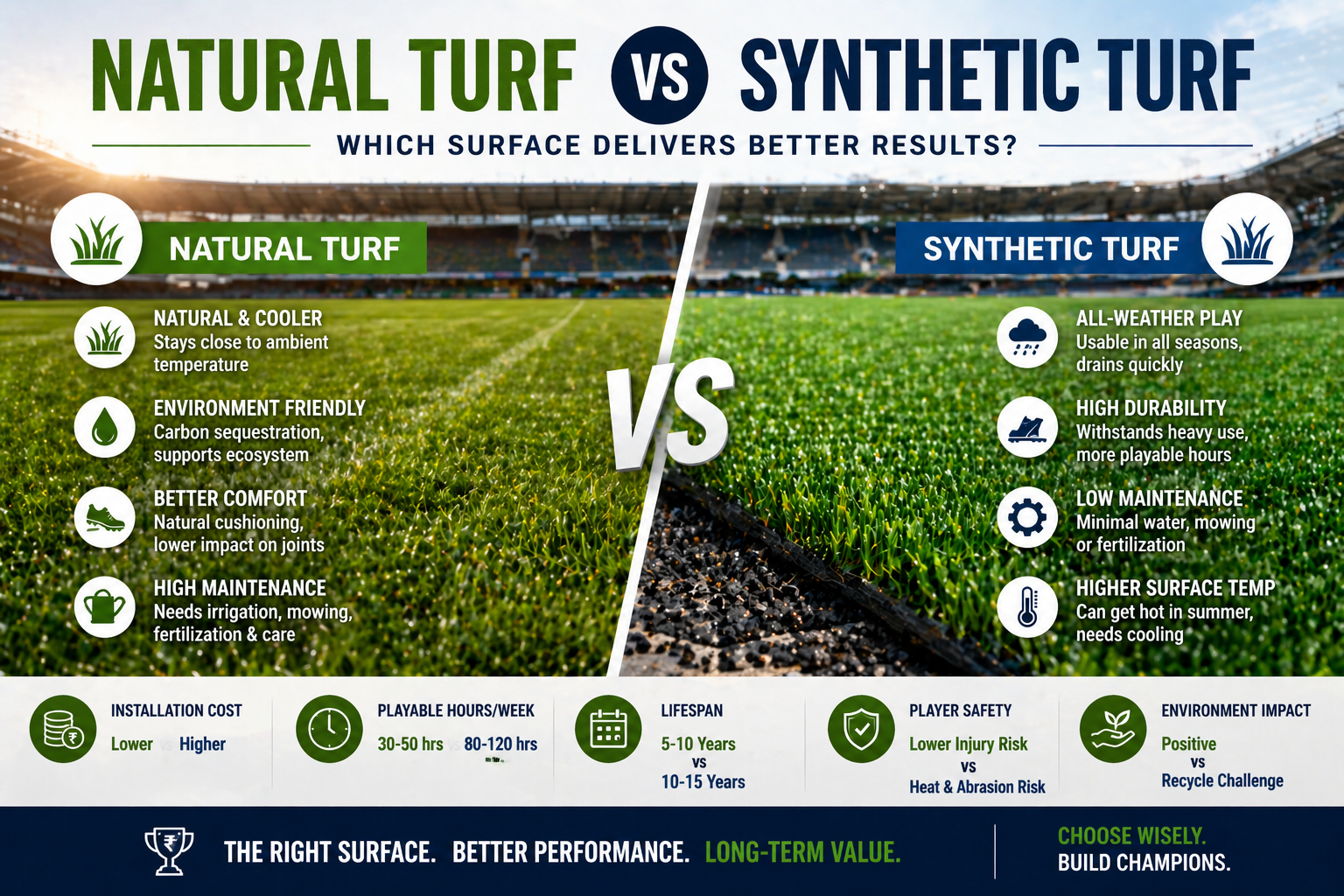
The table below provides a snapshot turf system comparison across the most important parameters:
| Parameter | Natural Grass Field | Artificial Sports Turf |
| Installation Cost | ₹3–8 lakh per 1,000 sq. m. | ₹12–30 lakh per 1,000 sq. m. |
| Annual Maintenance | ₹3–10 lakh / year | ₹50,000–2 lakh / year |
| Playable Hours/Week | 30–50 hours | 80–120 hours |
| Lifespan | 5–10 years | 10–15 years |
| Surface Temperature | Ambient or cooler | Up to 60–70°C in peak summer |
| Injury Risk | Lower on joints | Higher heat & surface abrasion |
| Environmental Impact | Carbon sequestration, cooling | Microplastic runoff risk |
| Weather Dependence | High | Low |
| FIFA/Sports Body Approval | Yes | Yes (certified grades) |
Performance on the Field: Which Surface Plays Better?
Ball Roll and Bounce Consistency
One of the most debated aspects in the natural turf vs synthetic turf for sports fields conversation is ball behaviour. Natural grass fields offer variable ball roll depending on moisture, grass height, and wear patterns — this unpredictability is considered part of the authentic game experience by many purists.
Artificial sports turf, by contrast, delivers consistent ball roll and bounce in all weather conditions. FIFA-certified artificial sports turf meets strict performance standards for ball rebound (60–65%) and roll (4–8 metres), making it ideal for training academies and competitions where surface uniformity matters.
Traction and Footing
Traction on a natural grass field is excellent in dry conditions but degrades rapidly in heavy rain, leading to slipping, divoting, and uneven footing. Artificial sports turf maintains consistent traction year-round, which is particularly valuable for sports like football, hockey, and tennis.
Surface Hardness and Shock Absorption
Natural grass fields provide inherent cushioning through the soil-root matrix, which allows them to absorb impact effectively. Similarly, high-quality artificial sports turf systems are designed to replicate this effect by incorporating shock pads beneath the fibre layer, making them a critical feature for player safety. As a result, independent tests indicate that premium turf systems with shock pads can achieve HIC (Head Injury Criterion) scores comparable to those of natural grass fields.
Cost Analysis: Installation, Maintenance, and Long-Term Value
Installation Costs in India
In India, installing a natural grass field for a standard football pitch (approximately 7,000 sq. m.) typically costs ₹20–55 lakh, as it includes soil preparation, drainage, seeding or sodding, and irrigation systems. In contrast, a comparable artificial sports turf installation using FIFA Quality Pro-certified material requires a significantly higher upfront investment, ranging from ₹85 lakh to ₹2.1 crore. This variation depends on factors such as fibre quality, infill type, and shock pad specifications.
Annual Maintenance: The Real Cost Difference
Natural grass fields demand continuous investment. Typical annual maintenance costs in India include:
• Mowing and edging: ₹1–2 lakh
• Fertilisation and pest control: ₹80,000–1.5 lakh
• Irrigation (water bills + system upkeep): ₹1.5–4 lakh
• Renovation and overseeding: ₹1–3 lakh
• Total annual outlay: ₹4–10 lakh per full-sized pitch
Artificial sports turf, after installation, requires only periodic brushing, infill top-ups, and seam checks — costing ₹50,000–2 lakh per year. Over a 10-year lifecycle, this maintenance saving can offset a significant portion of the higher upfront installation cost, making the turf system comparison more nuanced than initial quotes suggest.
Long-Term ROI for Sports Facilities
A natural grass field typically allows 30–50 hours of play per week, as it depends heavily on weather conditions and required recovery time. In comparison, artificial sports turf can accommodate significantly higher usage, handling 80–120 hours per week. As a result, for commercial academies, schools, and multi-use venues charging ₹1,000–5,000 per slot, this increased field utilisation can substantially boost revenue. Consequently, the higher initial installation cost of artificial turf can often be recovered within just 5–7 years.
Player Health and Safety: What the Research Says
Injury Rates: Natural Grass Field vs Artificial Sports Turf
Studies on injury rates across sports field surfaces present a mixed picture. Research published in major sports medicine journals suggests that artificial sports turf is associated with slightly higher rates of ankle sprains and skin abrasions compared to natural grass fields, primarily due to increased surface friction.
However, the quality and generation of artificial sports turf matter enormously. Older first- and second-generation systems were significantly harder. Modern third- and fourth-generation artificial sports turf with advanced infill and shock pads narrows this gap considerably.
Heat Stress: A Critical Concern in India
This is where artificial sports turf faces its most serious criticism for Indian climates. Studies have recorded surface temperatures on artificial sports turf reaching 60–75°C on summer afternoons in cities like Delhi, Hyderabad, and Nagpur. A natural grass field stays close to ambient air temperature due to evapotranspiration.
Heat stress from sports field surfaces is a genuine health risk for young athletes, and facility managers in India must weigh this factor carefully when evaluating natural turf vs synthetic turf for sports fields. Water-cooled and bio-infill turf systems can reduce surface temperatures by 15–25°C, though they add to cost.
Chemical Exposure Considerations
Crumb rubber infill (recycled tyres) in artificial sports turf has been studied for potential chemical leaching. While major regulatory bodies have not imposed outright bans, organic infill alternatives — cork, coconut coir, and thermoplastic elastomer (TPE) — are increasingly used, especially in Indian schools and youth academies prioritising chemical safety.
Environmental Impact: Sustainability of Each Surface
Natural Grass Fields and the Environment
A well-maintained natural grass field contributes positively to the local environment. Grass sequesters carbon, cools surrounding air, supports pollinators, replenishes groundwater, and reduces surface runoff through natural filtration. In urban settings, natural grass fields act as green lungs.
The environmental drawback is resource consumption: natural grass fields in India require 1.5–4 lakh litres of irrigation water per month during dry seasons, along with pesticide and fertiliser applications that can leach into groundwater.
Artificial Sports Turf and Environmental Concerns
Artificial sports turf eliminates irrigation water needs and pesticide use — significant advantages. However, manufacturing synthetic fibres involves petrochemicals, and end-of-life disposal of artificial sports turf remains a challenge globally. Most systems end up in landfill after 10–15 years, contributing microplastics to the environment.
Recyclable turf systems are emerging, with some manufacturers offering take-back programmes. When evaluating sports field surfaces from a sustainability standpoint, the picture is complex for both options.
Which Sports Benefit Most from Each Surface?
When a Natural Grass Field Excels
• Cricket: A natural grass field is preferred at professional levels for pitch behaviour and outfield play. The ICC mandates natural grass for Test and most first-class fixtures.
• Golf is entirely dependent on natural grass, as artificial alternatives are not sanctioned for professional play.
• Rugby also prefers natural grass surfaces, primarily due to the lower injury risk in high-impact situations.
• Elite football tournaments, including those governed by FIFA, are played on natural grass fields, as they prioritise tradition and authentic ball-play.
When Artificial Sports Turf Wins
In field hockey, international standards set by the International Hockey Federation (FIH) require the use of water-based or sand-filled artificial turf, as natural grass is not allowed at elite competition levels.
Multi-sport academies rely on artificial turf to support continuous, round-the-clock play across activities like football, tennis, futsal, and athletics.
For schools and colleges, artificial turf stands out as a practical solution due to its low maintenance needs and reliable all-weather usability.
Indoor sports arenas depend on artificial turf as the only suitable surface for consistent and safe indoor installations.
In regions facing extreme weather conditions, such as heavy monsoons or intense summer heat, artificial turf offers strong climate resilience and year-round usability.
Key Factors to Consider Before Making Your Decision
When conducting your own turf system comparison, evaluate these factors specific to your situation:
1. Budget and Lifecycle Cost
If upfront capital is limited, a natural grass field is more accessible. However, if annual operational savings and higher usage revenue are priorities, the long-term economics often favour artificial sports turf.
2. Climate and Location
High-rainfall monsoon regions can make natural grass field maintenance extremely challenging. Conversely, extreme heat cities must carefully address the surface temperature challenge of artificial sports turf. Both sports field surfaces require climate-specific planning.
3. Usage Intensity
A venue expecting 80+ hours of weekly use across multiple sports should, therefore, strongly consider artificial sports turf. On the other hand, a cricket club that primarily uses the field for weekend match days may find a natural grass field perfectly adequate for its needs.
4. Sport-Specific Governing Body Rules
Always verify your sport’s governing body requirements, as each sport has specific surface mandates. For example, field hockey requires artificial sports turf, whereas cricket and football at elite levels typically specify natural grass fields. Therefore, failing to comply with these standards can directly impact tournament eligibility and limit the facility’s professional use.
5. Environmental and Community Values
Facilities in environmentally sensitive locations, schools emphasising nature-based learning, and green-rated buildings may find natural grass fields better aligned with their values despite higher maintenance demands.
Hybrid Turf Systems: The Best of Both Worlds?
A growing number of elite venues worldwide are adopting hybrid turf systems, which combine natural grass with synthetic fibres injected into or woven through the soil profile. These hybrid sports field surfaces reinforce the natural grass root zone, dramatically improving wear tolerance while retaining the feel, temperature, and aesthetics of a natural grass field.
FIFA Quality Pro and World Rugby have approved hybrid systems for top-level competition. In India, hybrid turf systems are nascent but growing — installation costs range from ₹35–60 lakh per 1,000 sq. m. — positioned between standard natural and fully artificial options. They may represent the future sweet spot of this turf system comparison for serious sports venues.
Making the Right Choice: Summary Verdict
| Choose a Natural Grass Field If… | Choose Artificial Sports Turf If… |
| ✅ Your sport mandates it (cricket, elite football) | ✅ Your sport mandates it (field hockey, futsal) |
| ✅ You have access to skilled groundskeeping staff | ✅ You need low-maintenance, high-availability surfaces |
| ✅ Environmental sustainability is a priority | ✅ Budget for maintenance is tight but usage is high |
| ✅ You have reliable water access and irrigation budget | ✅ The venue operates year-round across multiple sports |
| ✅ Player experience on elite natural surfaces is key | ✅ Climate or drainage makes grass impractical |
There is no universally correct answer when comparing natural turf vs synthetic turf for sports fields. The best decision is always context-specific — driven by your sport, budget, climate, usage intensity, and long-term vision for your facility.
Conclusion
The natural turf vs synthetic turf for sports fields debate does not have a single winner — it has context-dependent answers. Natural grass offers authenticity and comfort but needs expert care, heavy water, and accepts weather limits. Artificial turf ensures durability, all‑weather play, and low upkeep, though with higher upfront cost and climate sensitivity in India.
For high‑usage academies and schools in India, artificial turf offers superior long‑term value, while elite venues with skilled groundskeeping still rely on natural grass as the gold standard.
Evaluate your specific sport requirements, available budget, climate zone, and usage goals against this turf system comparison — and you will arrive at the surface that truly delivers better results for your facility.
*Note: Prices are subject to change
Frequently Asked Questions
1: Which is cheaper to install — natural grass or artificial sports turf in India?
Natural grass fields typically have a lower upfront installation cost, ranging from ₹3–8 lakh per 1,000 sq. m. in India. In contrast, artificial sports turf requires a higher initial investment, usually between ₹12–30 lakh per 1,000 sq. m. However, when viewed over the long term, artificial turf offers significant advantages. Due to lower annual maintenance costs and the ability to support higher usage hours, it ultimately delivers greater value over a 10–15 year lifecycle.
2: Is artificial sports turf safe for children and young athletes?
Modern artificial sports turf certified by FIFA, FIH, or World Rugby is considered safe for children. Surface heat in summer can reach 60–70°C in Indian conditions. Infill type affects safety. Facilities should use organic or TPE infill instead of crumb rubber. Play sessions should be scheduled during cooler hours in peak summer.
3: How long does artificial sports turf last compared to natural grass?
A well-maintained natural grass field lasts 5–10 years before major renovation. Artificial sports turf lasts 10–15 years with proper maintenance. Maintenance includes brushing, infill top-up, and seam checks. High usage reduces lifespan. Disposal at end-of-life requires planning due to limited recycling options in India.
4: How does the monsoon season affect natural grass fields vs synthetic turf?
The Indian monsoon creates challenges for natural grass field management. Waterlogging, fungal disease, and surface damage occur under heavy use in wet conditions. Artificial sports turf drains through its permeable backing layer at 100–1,000 mm/hour. The surface remains playable after rain. This gives synthetic turf an advantage during monsoon months.
