
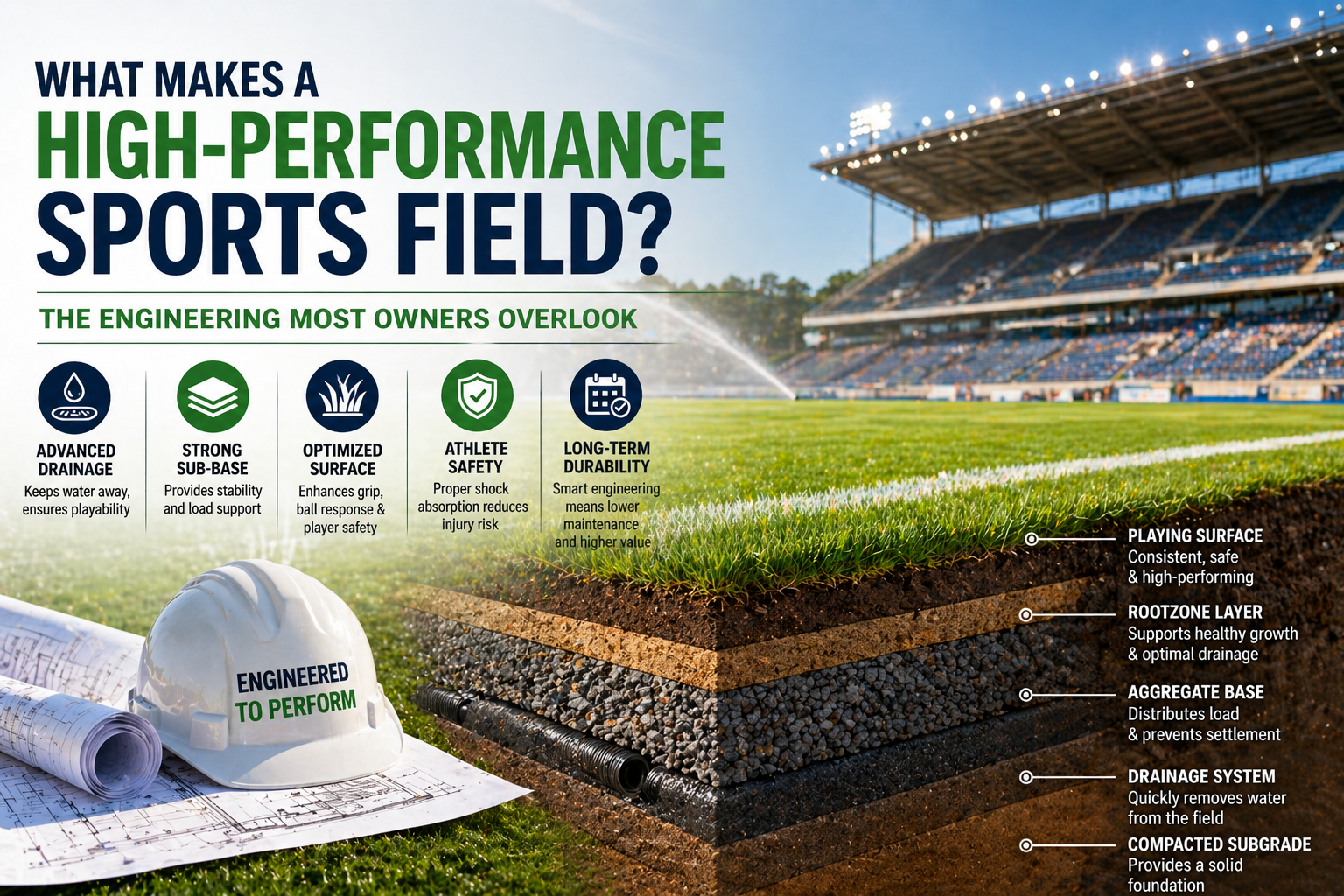
What does a high-performance sports field actually look like? From the stands, it looks like any other well-kept surface. The difference — the real difference — lives in the layers you cannot see.
Performance is built from the bottom up, and most owners never look down. They focus on visible elements — the colour of the turf, the width of the boundary lines, the type of floodlighting. Meanwhile, the engineering decisions that truly determine sports surface performance and long-term field durability go unexamined until something fails.
This article breaks down exactly what separates an average sports facility from a genuinely high-performance one — and which engineering factors most owners overlook until it is too late.
Why Surface Appearance Is the Least Important Factor
Walk onto any well-maintained sports field and it will likely look uniform, clean, and professional. But appearance tells you almost nothing about how the field will perform under pressure — specifically under the weight of athletes moving at high speed, under heavy rainfall, or after years of repeated use.
The visible surface layer accounts for perhaps 10 to 15 percent of what makes a field truly high-performing. The remaining 85 to 90 percent is determined by what you cannot see: the sub-base construction, the drainage architecture, the infill composition, the rootzone blend, and the compaction profile of every layer beneath your feet.
This distinction matters enormously because most budget decisions in sports construction are driven by visible elements. When cost-cutting happens, it almost always happens underground — in the layers that have the greatest impact on field durability, athlete safety, and sports surface performance over time.
Understanding what actually makes a field perform is the first step toward making smarter decisions during construction and procurement.
The Sub-Base: The Foundation That Everything Depends On
If there is one element of sports field engineering that is most frequently underbuilt, it is the sub-base. The sub-base is the engineered layer of aggregate material that sits beneath the playing surface and above the native ground. Its job is to distribute load, support drainage, and provide a stable, consistent platform for the layers above.
A poorly designed sub-base creates differential settlement — meaning some areas sink more than others under repeated load. This produces an uneven playing surface that affects ball roll, creates trip hazards, and accelerates surface wear unevenly across the field.
The quality of sub-base construction depends on several key variables:
The depth of the aggregate layer must be calibrated to the expected load — a community football pitch has different requirements from a professional training ground used daily by elite squads.
The aggregate material itself must meet specific gradation requirements. Using the wrong size or poorly graded aggregate creates voids that collapse under pressure or become clogged with fine particles over time.
Compaction must be uniform and verified through testing. Over-compaction can reduce drainage capacity. Under-compaction allows settlement. Getting this balance right requires proper equipment and systematic testing — not guesswork.
On a high-performance sports field, sub-base engineering is treated as a precision exercise, not a rough preparation step. The difference in long-term performance is dramatic.
Drainage Engineering: The Most Overlooked System in Sports Construction
If you ask most facility owners what caused their field to fail — whether through waterlogging, surface deterioration, or uneven performance — the answer almost always traces back to drainage. Inadequate drainage is the single most common cause of underperformance in sports surfaces worldwide.
Effective drainage on a high-performance sports field operates at three distinct levels, and all three must work together:
Surface drainage refers to the gradient of the playing surface itself. Governing bodies specify tight tolerances — typically a fall of 0.5 to 1 percent from crown to edge — to ensure water moves off the surface quickly after rainfall without creating puddles or affecting ball behaviour.
Sub-surface drainage involves a network of perforated pipes or drainage channels embedded within or beneath the aggregate layers. These collect water that percolates through the surface and channel it away from the field at a controlled rate.
Outfall drainage is the system that takes water away from the site entirely — connecting to stormwater drains, retention basins, or infiltration zones. Without adequate outfall capacity, even a perfectly designed on-field drainage system will back up under heavy rainfall.
The drainage design must account for local rainfall intensity data, soil permeability, surface type, and catchment area. This is not a one-size-fits-all calculation. An experienced sports field engineering team conducts hydrological analysis specific to the site before a single pipe is specified.
Drainage failures are expensive to fix because they often require excavation of completed surface layers. Getting drainage right during construction is far cheaper than correcting it afterward.
Rootzone and Growing Medium: The Science Beneath Natural Grass
For natural grass sports fields, one of the most technically sophisticated components is the rootzone — the engineered growing medium in which the grass establishes and survives heavy use. This is where sports field engineering intersects directly with soil science, agronomy, and plant physiology.
A standard topsoil is not suitable for high-performance grass surfaces. It compacts under foot traffic, drains poorly after rain, and does not provide the consistent physical properties that elite sports demand. Instead, high-performance natural grass fields use a precisely blended rootzone — typically a sand-dominant mix conforming to specifications such as the USGA method or equivalent standards.
The sand content is high — often 80 to 85 percent by weight — which provides the drainage capacity and resistance to compaction that sports fields require. The remaining organic material is carefully selected and proportioned to provide just enough nutrient-holding capacity and biological activity to support healthy grass growth without compromising drainage.
This rootzone must be installed at a precise depth, on a compatible drainage layer below, and must be uniformly consolidated — not compacted — before turfing or seeding. Any inconsistency in the mix, the depth, or the consolidation profile will show up later as uneven growth, differential hardness, or localised drainage failure.
Maintaining a healthy rootzone over the long term also requires active management: aeration, topdressing with compatible sand, and periodic testing of the physical properties. A high-performance grass surface requires ongoing sports field engineering input, not just initial construction.
Surface Layer Selection and Sports Surface Performance
The choice of playing surface — whether natural grass, synthetic turf, or hybrid systems — has profound implications for sports surface performance, athlete safety, and maintenance requirements. This decision should always be driven by technical assessment, not aesthetics or initial cost alone.
Natural grass provides the surface characteristics most preferred by athletes in many sports — a degree of natural give, consistent grip when properly maintained, and a playing experience that synthetic surfaces approximate but do not fully replicate. Its limitation is recovery time: a heavily used natural grass surface needs rest periods to regenerate, which is impractical for high-use facilities.
Synthetic turf systems have advanced enormously in recent years. Modern third-generation synthetic surfaces with carefully specified infill materials — typically a combination of sand and rubber or organic infill — can deliver excellent sports surface performance within tightly controlled parameters. They support play in weather conditions that would damage or render natural grass fields unsafe, and they require no rest periods for recovery.
Hybrid systems — which integrate synthetic fibres stitched or injected into a natural grass rootzone — represent a growing middle ground. They provide the natural feel of grass with significantly improved durability and resistance to wear. Many elite professional stadiums now use hybrid pitches for these reasons.
Each surface type has specific installation requirements, governing body certification standards, and performance testing protocols. A surface that looks correct but fails laboratory performance testing for shock absorption, vertical deformation, or energy restitution is not a high-performance sports field regardless of how it appears.
Shock Absorption and Athlete Safety: The Numbers That Protect Players
One of the most direct connections between sports field engineering and athlete safety is the field’s shock absorption capacity — its ability to cushion the impact forces that athletes generate through running, jumping, landing, and changing direction.
Inadequate shock absorption increases the loading on joints, muscles, and connective tissues. Over time — and sometimes in a single incident — this contributes to knee injuries, stress fractures, ankle damage, and chronic lower limb conditions. The type of surface, the type and depth of infill material, and the stiffness of the sub-base layer all influence shock absorption.
International standards set measurable benchmarks for acceptable performance. For synthetic football surfaces, FIFA specifies that shock absorption must fall between 55 and 70 percent — a surface that is too hard (below 55 percent) increases injury risk, while one that is too soft (above 70 percent) reduces performance and stability.
For natural grass, hardness testing using devices such as the Clegg Impact Hammer gives a numerical hardness value that can be tracked over time. A field hardness index that rises sharply after dry weather signals increased injury risk and should trigger proactive management — irrigation, aeration, or restricted use.
Line Marking, Orientation, and Microclimate Considerations
Seemingly minor design decisions can have meaningful effects on field performance and athlete safety. Orientation is one of them. The standard recommendation for most outdoor sports is a north-south field orientation, which minimises the impact of low-angle sunlight during morning and afternoon play. A field oriented east-west can leave goalkeepers, batters, or receivers staring directly into the sun during critical moments — a genuine safety issue, not merely a comfort preference.
Microclimate factors such as prevailing wind direction, shade from adjacent structures, and altitude all affect how the surface behaves. Wind can dry a natural grass field unevenly, creating localised hard spots. Shade prevents drying after rain, increasing the risk of disease in grass surfaces and algae growth on synthetic ones.
Line marking materials must be compatible with the surface type. Incorrect marking products applied to synthetic turf can damage fibres, interfere with infill behaviour, and void manufacturer warranties. On natural grass, environmentally appropriate marking materials preserve grass health.
Floodlighting and Playing Surface Interaction
Floodlighting is often treated as a separate procurement exercise — selected by electrical engineers without input from the sports field specialist. This is a missed opportunity, because floodlighting has a direct and often underestimated impact on sports surface performance.
On natural grass, floodlighting can be used to supplement photosynthesis through specialised grow-light systems, enabling grass to thrive beneath stadium roofs or in stadiums with orientation that limits natural daylight. Without this intervention, grass in shaded areas struggles, creating thin, weak turf exactly where player traffic is heaviest.
The uniformity of lighting across the playing surface affects how athletes perceive depth, speed, and trajectory. A field with poor lighting uniformity — where some zones are significantly brighter than others — creates perceptual challenges that affect performance and, in fast-moving sports, increase accident risk.
Lux levels, beam angles, uniformity ratios, and glare control are all measurable parameters that should be specified based on the intended use of the facility — training versus competition, broadcast versus non-broadcast events.
Long-Term Maintenance Planning as an Engineering Responsibility
A high-performance sports field is not a static construction — it is a living system that requires ongoing technical management. One of the most significant gaps in most facility ownership models is the failure to plan for maintenance from the very beginning of the project.
Maintenance requirements should be defined at the design stage and communicated to the facility operator before construction begins. This includes:
The correct aeration schedule and method for the surface type — solid tine, hollow tine, deep-slit aeration depending on compaction depth.
Infill top-up schedules for synthetic surfaces, which lose rubber or sand over time through displacement and degradation.
Inspection and flushing schedules for drainage systems, which can become blocked with organic material, fine particles, or root intrusion over time.
Periodic performance testing to verify that the surface continues to meet governing body standards — particularly critical if the facility hosts sanctioned events.
Facilities that invest in a planned maintenance programme from day one consistently outperform those that react only when problems become visible.
Conclusion
A high-performance sports field is the product of dozens of engineering decisions — most of them invisible once construction is complete. The drainage architecture, sub-base design, rootzone composition, surface selection, and maintenance programme all interact to determine whether the facility performs at the standard athletes deserve and owners intend.
The engineering that most owners overlook is precisely the engineering that matters most. In fact, drainage failures, sub-base settlement, and inadequate shock absorption are not simply acts of bad luck. Instead, they are the predictable consequences of decisions made without sufficient technical depth.
Therefore, it is vital to invest in sports field engineering expertise from the earliest stage of planning. Furthermore, maintaining that technical engagement throughout the life of the facility is what separates a field that performs for a decade from one that disappoints within a season.
Ultimately, you must build it right and maintain it intelligently because the athletes who use your facility—and the organization that owns it—deserve nothing less.
Frequently Asked Questions
1. What is the most important engineering element of a high-performance sports field?
There is no single most important element — a high-performance sports field functions as an integrated system. However, drainage engineering is commonly the deciding factor between a field that performs consistently and one that fails under pressure. Without effective drainage at surface, sub-surface, and outfall levels, no other engineering investment will deliver its intended performance.
2. How does sports field engineering affect athlete safety directly?
Sports field engineering affects athlete safety through shock absorption, surface hardness, grip consistency, and drainage performance. A field that is too hard transfers excessive impact force to joints and bones. Uneven drainage creates slippery zones. Poor sub-base construction creates surface irregularities that increase trip and stumble risk. Every major engineering decision has a direct or indirect effect on the safety of athletes using the facility.
3. Can a natural grass field meet the same performance standards as synthetic turf?
Yes — A well-engineered natural grass field can match or even outperform synthetic surfaces in comfort, grip, and temperature. However, it needs recovery time after heavy use and is affected by weather. Hybrid turf solves this by combining natural grass with synthetic fibres, improving durability while maintaining playing quality.
4. Why does field orientation matter for sports surface performance?
Field orientation is crucial because it determines the angle of sunlight falling on the playing area at different times of day. Specifically, poor orientation can create significant sun glare for players. Furthermore, it can create uneven drying patterns that affect surface hardness and grip. In addition, shaded areas may experience limited photosynthesis in natural grass surfaces. For these reasons, a north-south orientation remains the industry standard for most outdoor sports.
