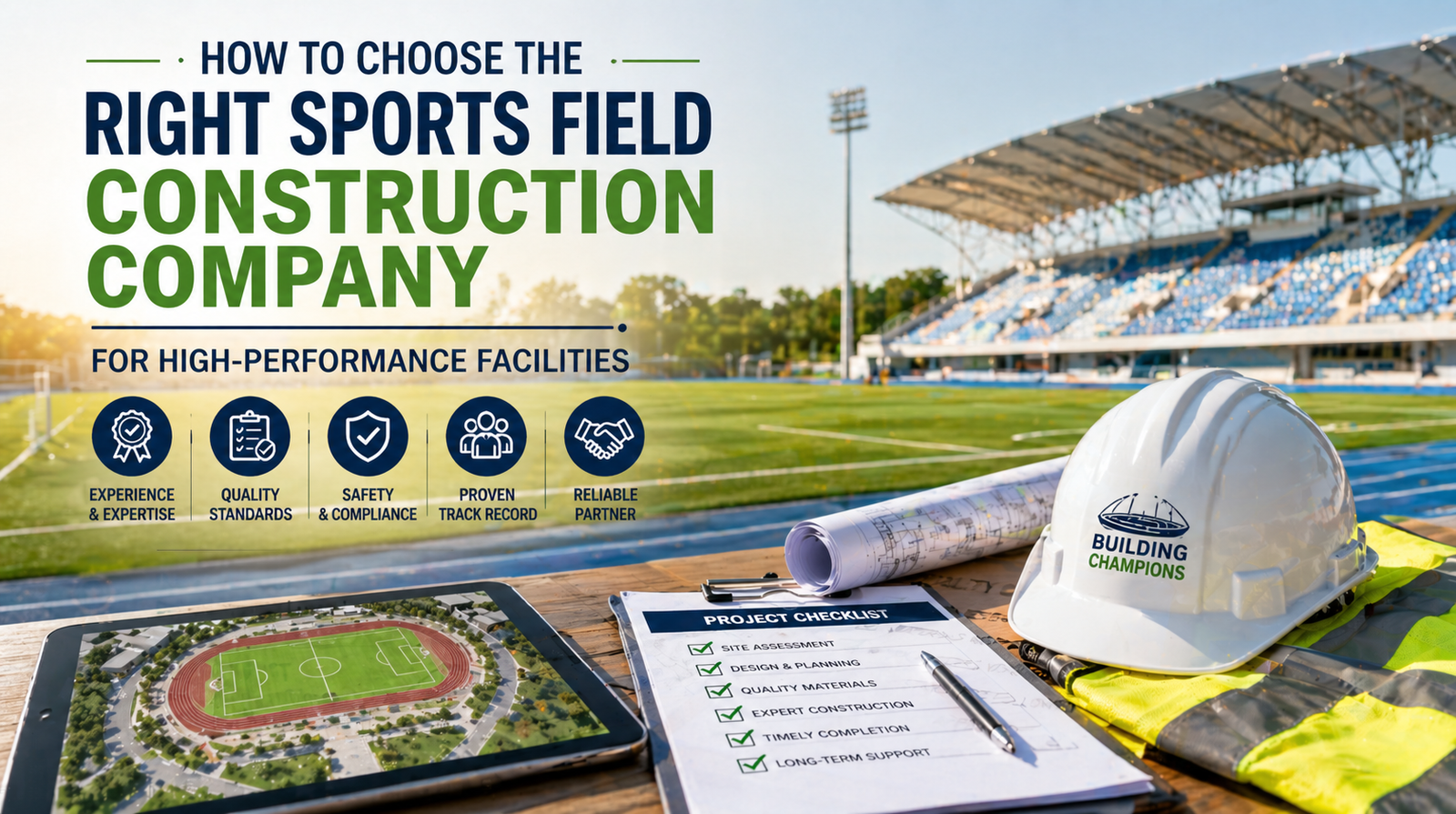
Building a world-class athletic venue is not simply about laying down turf and drawing boundary lines. It is a long-term investment that demands careful thought, the right expertise, and a trusted partner who understands every dimension of sports infrastructure. Whether you are developing a community football ground, a professional cricket stadium, or a multi-purpose athletics complex, choosing the correct sports field construction company can make or break the entire project.
The decision involves far more than price comparisons. You must assess technical competency, past project portfolios, knowledge of regulatory standards, drainage engineering, surface materials, and long-term maintenance capabilities. A qualified sports facility contractor brings all of these together under one roof and guides you from concept to completion.
This article walks you through every critical factor you need to evaluate before signing a contract, helping you make a confident, informed decision for your sports facility investment.
Why Your Choice of Sports Field Construction Company Matters
Many project owners underestimate the complexity of field development until they are mid-project and facing costly delays or structural failures. A poorly selected contractor may cut corners on sub-base preparation, drainage systems, or surface materials — resulting in uneven playing surfaces, waterlogging, or premature deterioration.
The right sports infrastructure company brings certified engineers, experienced project managers, and domain-specific knowledge that aligns with the type of sport being played. A synthetic football pitch has completely different technical requirements from a clay tennis court or a rubberised athletics track. Expertise in one does not automatically translate to another.
Furthermore, working with a credible sports field construction company ensures compliance with national and international sports body standards — whether FIFA, World Athletics, ICC, BWF, or others. This is particularly critical if your facility will host competitive or sanctioned events.
Step 1: Define Your Project Scope Before Approaching Any Contractor
Before reaching out to any sports facility contractor, you must have a clearly defined project scope.
This includes:
Type of sport or sports: Will this be a single-sport or multi-sport facility? A dedicated venue or a shared-use complex?
Surface type preference: Natural grass, synthetic turf, clay, hardcourt, or rubberised surfaces each carry unique construction, maintenance, and budget implications.
User volume and intensity: A school ground serving 200 students per day has different durability requirements than a professional training ground used by elite athletes.
Budget range: While precise costs emerge only after site assessment, having a realistic budget range allows contractors to propose suitable solutions without over-engineering or under-delivering.
Timeline requirements: Is there an event, season, or deadline driving the project? Good sports project planning accounts for weather windows, curing times, and equipment availability.
Having answers to these questions ready before your first consultation saves time and ensures the contractor proposals you receive are genuinely aligned with your goals.
Step 2: Evaluate the Company’s Track Record in Sports Infrastructure
Not every civil construction firm has the specialised experience required to deliver a high-performance sports facility. When shortlisting candidates, look specifically at their portfolio within the sports infrastructure domain.
Ask to see completed projects similar in scale and sport type to yours. A company that has successfully built multiple football grounds, athletics tracks, or indoor sports halls will bring proven knowledge of the technical and logistical challenges specific to those facilities.
Pay attention to:
Years of experience: A company with a decade or more of focused field development projects typically has refined systems for quality control, procurement, and project delivery.
Geographic reach: Companies with experience across different regions often handle varied soil conditions, climate considerations, and local regulatory requirements more effectively.
Client testimonials and references: Reach out to previous clients directly. Ask about project delivery timelines, budget adherence, communication quality, and post-construction support.
A reputable sports field construction company will be transparent about its project history and will willingly provide references. Hesitation on this point is a warning sign.
Step 3: Assess Technical Expertise and Engineering Capabilities
Sports field construction is deeply technical. The foundation layers, drainage gradients, compaction levels, and surface specifications must all meet precise standards. Evaluating the technical depth of a sports facility contractor is therefore non-negotiable.
Sub-base engineering: The performance and longevity of any sports surface depend heavily on the quality of the sub-base. Ask how the contractor approaches soil analysis, compaction testing, and base material selection.
Drainage systems: Poor drainage is one of the most common causes of waterlogged or flooded fields. A qualified sports infrastructure company designs drainage systems that match the site’s rainfall data, soil permeability, and surface type.
Surface installation expertise: Whether installing FIFA-certified synthetic turf, IAAF-approved athletics tracks, or ITF-classified tennis courts, the installation team must follow precise manufacturer and governing body specifications.
Equipment and machinery: Modern sports field construction requires specialised equipment for laser-guided grading, compaction monitoring, and line marking. Ensure the contractor owns or has reliable access to the necessary machinery.
In-house vs. subcontracted work: Understand how much of the construction is done in-house versus subcontracted. Heavy reliance on subcontractors can dilute accountability and increase coordination risks.
Step 4: Verify Certifications, Affiliations, and Compliance Standards
A credible sports infrastructure company will hold relevant certifications and affiliations with sports governing bodies. These credentials indicate that their products and methods meet internationally accepted performance benchmarks.
Look for certifications and approvals such as:
- FIFA Quality Programme certification for synthetic football surfaces
- World Athletics approval for running tracks and field event areas
- ITF (International Tennis Federation) classification for tennis courts
- ICC and BCCI compliance for cricket pitches and outfields
- ISO quality management certifications for project delivery processes
- BIS or ASTM standards for construction materials used in the project
Membership in industry bodies such as the Sports Turf Managers Association (STMA), the Institute of Groundsmanship (IOG), or national construction federations also adds credibility to the contractor’s professional standing.
Always verify certifications directly with the issuing body rather than relying solely on the contractor’s claims.
Step 5: Understand Their Approach to Sports Project Planning
Effective sports project planning is what separates a well-executed facility from a chaotic, over-budget construction disaster. During early conversations, evaluate how the contractor structures the planning phase.
A strong contractor will:
Conduct a detailed site assessment before proposing any design. This includes topographic surveys, soil testing, drainage analysis, and utility mapping.
Develop a phased project plan with clear milestones, responsible parties, and quality checkpoints at each stage.
Engage you in design decisions — from surface orientation and spectator provisions to lighting specifications and accessibility compliance.
Provide transparent cost breakdowns that distinguish between fixed and variable elements, allowing you to make informed budget decisions.
Identify risk factors upfront — weather dependencies, material lead times, regulatory approvals — so contingency plans are built in from the start.
Poor planning at the outset often leads to design changes mid-construction, which are expensive, time-consuming, and sometimes structurally compromising. The best sports field construction companies invest heavily in this phase because it protects both parties.
Step 6: Evaluate Communication, Transparency, and Project Management
Even technically excellent companies can fail clients through poor communication. A major construction project demands consistent, clear, and proactive communication between the contractor and the client.
During the evaluation phase, note:
Response times: How quickly does the company respond to your initial inquiries? Slow responses at the sales stage often predict slow responses during construction.
Dedicated project manager: Will you have a single point of contact throughout the project? A dedicated project manager reduces miscommunication and ensures accountability.
Progress reporting: Ask how the company communicates project updates. Regular site reports, photographic documentation, and scheduled review meetings are signs of a professional operation.
Problem escalation processes: How does the company handle unexpected issues on site? A mature sports facility contractor has clear internal escalation processes and communicates challenges promptly rather than concealing them.
Transparency builds trust. A company that gives you honest assessments of challenges, timelines, and costs — even when the news is inconvenient — is one you can rely on throughout the project and beyond.
Step 7: Examine Post-Construction Support and Maintenance Services
A high-performance sports field is not a one-time investment. Surfaces degrade, drainage systems require periodic clearing, line markings fade, and sub-surface compaction can change over time. Choosing a sports infrastructure company that offers robust post-construction support can significantly extend the life and performance of your facility.
Enquire about:
Warranty terms: What is covered, for how long, and what conditions could void the warranty?
Maintenance programmes: Does the company offer annual maintenance contracts for mowing, aeration, decompaction, infill replenishment (for synthetic turf), or resurfacing services?
Emergency response: What support is available if a surface defect or drainage failure occurs during or after the warranty period?
Training for facility staff: Does the company offer guidance to your ground staff on day-to-day maintenance practices to protect the investment?
Long-term partnership with a trusted sports field construction company delivers much better lifecycle value than choosing the cheapest initial build with no aftercare support.
Step 8: Compare Proposals Thoughtfully — Not Just on Price
Once you have shortlisted two or three contractors following the evaluation steps above, the proposal comparison stage requires careful thinking. It is tempting to select the lowest bid, but this approach frequently leads to disappointing outcomes in sports construction.
When comparing proposals, look at:
Scope clarity: Does each proposal cover the same scope? Sometimes lower bids exclude items that other proposals include — such as drainage works, line marking, or lighting.
Material specifications: Are the same quality materials being proposed? The difference between a FIFA Quality and FIFA Quality Pro certified synthetic turf, for example, is significant in cost and performance.
Project timeline: Is the proposed timeline realistic? An unusually fast completion promise can mean corner-cutting in curing, settling, or quality inspection stages.
Payment structure: Avoid contractors who demand disproportionately large upfront payments. A milestone-based payment structure protects your investment.
Value-added inclusions: Some contractors include site supervision, post-installation inspections, or staff training at no additional cost — genuine value that is easy to overlook when focused on headline prices.
The most competitively priced proposal is not always the most economical choice when total project lifecycle is considered.
Red Flags to Watch Out for When Selecting a Sports Facility Contractor
Being able to identify warning signs early saves you from costly mistakes. Avoid contractors who:
- Cannot provide verifiable references from past sports infrastructure projects
- Are unable or unwilling to share material specifications and certifications
- Pressure you into signing contracts before a site assessment has been completed
- Offer vague or bundled cost breakdowns with little transparency
- Lack dedicated sports construction experience and rely on generic civil works credentials
- Have unresolved complaints or poor reviews from previous clients
- Subcontract the majority of the work without disclosing this upfront
Trust your instincts during the evaluation process. If something feels unclear or rushed, request clarification before proceeding.
The Long-Term Value of Getting It Right
Investing in the right sports field construction company from the start pays dividends over the entire life of the facility. A well-built sports field reduces ongoing maintenance costs, performs consistently under heavy usage, meets the expectations of athletes and organisers, and retains its structural integrity for years — sometimes decades.
Beyond the physical structure, a high-quality sports facility elevates the reputation of the organisation that manages it. Schools, clubs, municipalities, and private sports operators all benefit from facilities that athletes want to train in, spectators enjoy visiting, and governing bodies are comfortable sanctioning events at.
The time you invest in selecting the right sports facility contractor is time well spent.
Conclusion
Selecting the right sports field construction company is one of the most consequential decisions you will make for your sports facility. The process requires moving beyond surface-level promises and examining track records, technical capabilities, certifications, planning methodologies, communication standards, and long-term support structures.
A qualified sports infrastructure company treats your project as a partnership — not just a transaction. They bring engineering expertise, transparent communication, and a genuine commitment to delivering a facility that performs at the highest level for years to come.
Take the time to conduct thorough due diligence. Ask the right questions, verify the credentials, and compare proposals with a clear eye for quality and total value. When you make the right choice, your facility becomes a lasting asset — one that inspires athletes, serves communities, and stands as a benchmark for high-performance field development done right.
Frequently Asked Questions
1. How do I know if a sports field construction company is genuinely experienced in my sport?
Ask to see a specific portfolio of projects in your sport type. Request references from those clients and verify the certifications the company holds for that surface type. Experience in cricket pitch construction, for example, is very different from experience in synthetic football turf installation. Governing body approvals for their completed projects are the strongest indicator of relevant expertise.
2. What is the typical timeline for a sports field construction project?
Timelines vary significantly depending on surface type, project scale, and site conditions. A standard natural grass football field may take 3 to 6 months from groundbreaking to completion, while a synthetic surface with sub-base and drainage works can be completed in 6 to 12 weeks once materials are on-site. Larger multi-sport complexes or projects requiring planning permissions may take 12 to 24 months. A reliable sports project planning process will give you a realistic milestone schedule upfront.
3. What certifications should a sports infrastructure company ideally hold?
The most relevant certifications depend on the sport and surface type. FIFA Quality certification matters for synthetic football surfaces. World Athletics approval is essential for athletics tracks. ITF classification applies to tennis courts. For general quality assurance, ISO 9001 certification for project management processes is a strong indicator. Always verify certifications directly with the issuing body.
4. Should I choose a local sports facility contractor or a national company?
Both have merits. Local contractors often have better knowledge of local soil conditions, climate patterns, regulatory requirements, and supplier relationships. National companies may offer broader technical resources, larger equipment fleets, and more diverse project portfolios. The most important factor is relevant experience and verifiable track record — regardless of geography.
5. What is the difference between natural grass and synthetic turf for sports fields?
Natural grass provides a traditional playing experience and is preferred for elite competitions in many sports. It requires regular mowing, watering, aeration, and seasonal resting. Synthetic turf offers high durability, consistent performance in varied weather, and significantly lower ongoing maintenance requirements, though it has higher upfront installation costs and requires periodic infill replenishment. A qualified sports field construction company can assess which surface is most appropriate for your usage intensity, climate, and budget.
6. How important is drainage in sports field construction?
Drainage is arguably the most critical technical element of any sports field project. Inadequate drainage leads to waterlogged surfaces, cancelled matches, surface degradation, and unsafe playing conditions. A professional sports infrastructure company designs drainage systems based on site-specific rainfall data, soil permeability tests, and surface type specifications. Never underestimate or cut budget on drainage systems — the consequences are almost always more expensive to fix than to prevent.
7. What post-construction support should I expect from a sports field construction company?
Reputable companies provide a minimum of 12 months warranty on workmanship and materials, along with a clear process for reporting and resolving defects. Many leading contractors also offer annual maintenance programmes, resurfacing schedules, and training for your grounds staff. Before signing any contract, clarify warranty coverage terms, exclusions, response time commitments for defect reports, and the availability of long-term maintenance service agreements.
